Showing posts with label slang. Show all posts

Sunday, 7 August 2011

Dibbles, Strunts and Dick Emery

I recently chanced across this rather peculiar sketch (I believe from the 1970s), which formed part of the Dick Emery Show. The joke here is that a prudish vicar tries to avoid using words that might have double meanings by inventing meaningless words. His daughter’s boyfriend, however, happens to be an expert on 17th and 18th century slang and he realises that the vicar’s ‘meaningless’ words are, in fact, much ruder than the words they replace.


For experts in historical slang, this sketch must have seemed peculiarly subversive since it gave Emery the opportunity of using a string of obscene words on a mainstream television show aimed at a family audience.

The four crucial words used are: dibble, placket, pizzle and strunt. Of these I immediately recognised two. Pizzle is a word meaning penis, usually an animal’s penis. Since a pig’s pizzle features prominently in Thomas Hardy’s Jude The Obscure, I think it’s reasonable to assume that quite a few viewers of The Dick Emery Show would have recognised the word.

Placket is slightly more obscure, I suppose. However, anyone who’s seen or read many Elizabethan and Jacobean plays will probably have a fair idea of its meaning. It was, at the time, a fairly common slang word for ‘vagina’ (apparently it originally referred to a slit in a petticoat). A typical example comes from Webster’s ‘Duchess of Malfi’:
MAD ASTROLOGER: What's he, a rope-maker?
MAD LAWYER: No, no, no, a snuffling knave, that while he shows the tombs, will have his hand in a wench's placket.

Which just leaves ‘dibble’ and ‘strunt’. In my innocence, the only Dibble I’d ever come upon previously was Officer Dibble in the cartoon, Top Cat. I had to refer to Green’s Dictionary Of Slang for more help. This says that dibble can mean ‘moustache’ (which isn’t rude enough for the Dick Emery sketch) or ‘penis’ (aha! that’s it!). The Dictionary entry is not over-burdened with examples though. The primary one being from 1796 when Robert Burns wrote: “Hey for the gardener lad, To gully away wi his dibble”. Since gardeners still use implements called ‘dibbers’ to make holes in the soil when planting, this example doesn’t strike me as conclusive. It could be a bawdy double entendre. Then again, it might be entirely innocent. I’ve read the original poem (‘Brose and Butter’) and I conceded that the vulgar meaning is quite probably (but not certainly) unintended:
And hey for the gardener's lad,
To gully away wi' his dibble.
My dad sent me to the hill,
To pull my lassie some heather;
And drive it in your fill,
Ye're welcome to the leather.

Even so, I find it odd that there is not a greater range of examples. Was ‘dibble’ really a slang word for penis or did Burns ‘invent’ a double entendre (if such it be) solely for this poem?

Strunt is similarly obscure. Green says it means the “the flashy part of an animal’s tail” and by association, the penis. He quotes Middleton (1608): “consenting she, his art’rizde strunt he drew...” (Incidentally, I had to look up art’rizde too. Apparently, it means “equipped to convey vital spirits”). But the use of ‘strunt’ in this sense seems to be unusual and I haven’t been able to find other examples.

I’d be interested to know who wrote this Dick Emery sketch. Whoever it was certainly knew their way around the highways of byways of historical slang!

Sunday, 30 January 2011

The Great Merlini Does The Full Monte

See if you can make sense of this....
“I was tossing broads on the backstretch at Saratoga. There was a fly gee in the tip with a big mittful of folding scratch. He thought he could pick me up, so I let him see me take out the crimp. Then I crossed him by putting it back in the same broad! He was all set to spring when Paper-Collar Ed, who was weeding the sticks, rumbled the gaff trying to duke the cush back to me. Another savage blowed it, sneaked out and beefed to the fuzz. The mark knew the big fellow, and the coppers had to turn on the heat. Ed and I were sneezed before we could slough the joint, and then the fix curdled. The robe was all set to hand us a ninety-day jolt when...”

OK, here’s a clue. It’s about a three-card monte game. This is a rigged gambling game, also called ‘Find The Lady’, in which someone mixes and tosses three cards onto a table or newspaper or some other flat surface and gullible gamblers have to bet on the final position of a certain card (often, but not necessarily, a queen or ‘broad’).

Three three-card monte
The dealer often bends a corner of a card (puts a ‘crimp’ in it) to make the gambler (the ‘sucker’ or ‘mark’) think that he will be able to spot the right card. I should point out that, having studied three-card monte myself (purely for research purposes, you understand!), the mark can never win. If the dealer is doing the three-card monte properly, the odds are stacked 100% in his favour.

OK, now here’s a line by line translation:

I was tossing broads on the backstretch at Saratoga.
I was running a three-card-monte game at the race in Saratogo.

There was a fly gee in the tip with a big mittful of folding scratch.
There was a wise guy in the crowd who knew how the swindle was worked. He had a fistful of paper money.

He thought he could pick me up, so I let him see me take out the crimp.
He thought he could beat me at my own game, so I let him see me straighten out the bent corner.

Then I crossed him by putting in back in the same broad!
Then I double-crossed him by replacing the bend in the same card!

He was all set to spring when Paper-Collar Ed, who was weeding the sticks, rumbled the gaff trying to duke the cush back to me.
He was all ready to bet when Paper-Collar Ed, who was retrieving the money that other members of the mob had been allowed to win as a come-on, wasn’t successful in concealing the fact that he was passing money back to me.

Another savage blowed it, sneaked out and beefed to the fuzz.
Another sucker saw it, sneaked out and called the cops.

The mark knew the big fellow, and the coppers had to turn on the heat.
The sucker had a pull and the police were forced to take action.

Ed and I were sneezed before we could slough the joint, and then the fix curdled. The robe was all set to hand us a ninety-day jolt when...
Ed and I were arrested before I could stop the game and clear out, and then the protection money that had been paid out to the authorities didn’t do its work. The magistrate was about to give us a ninety-day sentence when...

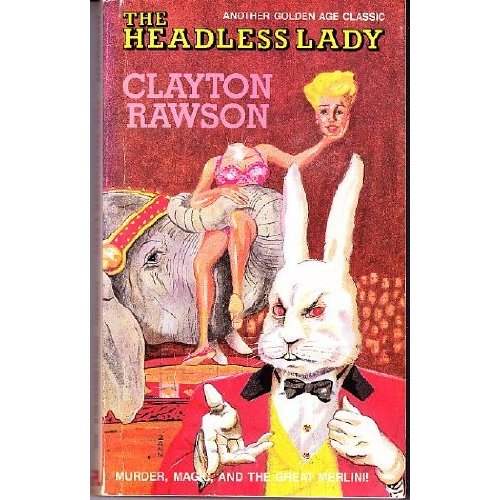
This passage is taken from a novel called The Headless Lady, which was written by a professional magician named Clayton Rawson in 1940. Rawson wrote four mystery novels featuring a conjurer called The Great Merlini. This novel takes place in a circus and it is stuffed full of wonderful slang, jargon and technical terms relating to magic, the circus, gambling and con men. Rawson helpfully explains most of the words in footnotes, which is how I arrived at the translation above. I must say though, that even some of his translations baffle me a bit (what does "The sucker had a pull" mean?).

Anyway, if you have a chance to get this novel, do so. It’s worth it for the lingo alone. As an added bonus, it is also a cracking good story!

Saturday, 1 January 2011

Green’s Dictionary Of Slang, Filth and Rick Astley

I received (nay, I demanded with menaces!) a copy of the new three volume Green’s Dictionary Of Slang from my dearest beloved as a Christmas present. Unfortunately, due to other commitments related to the unfortunate necessity of earning hard cash, I have not yet had the chance to study it in depth.

I shall therefore defer giving my considered opinion on this mighty oeuvre until a later date. In the meantime, you may want to take a look at Colin MacCabe’s review in the New Statesman. Apart from his views on the Dictionary itself, MacCabe also provides a few interesting titbits on Mr Green. For some reason, I had formed a picture of Jonathon Green as a dusty academic who, when he’s not researching Anglo-Saxon epic verse or High German alliterative poetry, gravitates towards the dark library cellars containing learned tomes of historical smut. So I was surprised to discover that Mr Green had formerly written for such academic journals as Rolling Stone, International Times and Oz and his previous publications includes such eminent titles as The Big Book of Filth and The Big Book of Bodily Functions.

This heartens me greatly. Speaking as the writer of such fine works as The Mega-pop Trivia Quiz Book, the Bruce Willis Special Edition Poster Magazine and The Pet Shop Boys Mega Mix Annual (many of which are still available from Amazon sellers) and also as the publisher of 18 Rated Magazine (banned by Mssrs W H Smith and all good newsagents) I feel in good company. Indeed, I see that Mr Green was employed by the Felix Dennis publishing company so it is entirely possible that we have passed upon the stairs at some time or another. I used to edit a magazine (The PC Buyer’s Guide) published by Dennis and I’ve been a columnist and reviewer for various other Felix Dennis magazines too.

Ah, if only I had devoted my life to the study of vulgarity, perhaps I too might have ascended to the heights of Jonathon Green! Alas, I remain but an amateur of the vulgar tongue. So while my best chance at everlasting fame is, perhaps, my celebrated ‘1988 Rick Astley Special’, Jonathon Green has given the world his wonderful dictionary. O! the cruel twists of fate!

Saturday, 27 November 2010

Lickety splits: two nations divided by a common language

The 1950 Manchester Guardian stylebook gravely listed "Americanisms" to avoid, including "aim to do" (instead of "aim of doing"), "balding", "to call" (rather than "to telephone"), "to contact", "to date" (rather than "so far"), "to help him finish the job" (instead of "to help him to finish the job"), "high-ranking officer", "to pinpoint", "teen-ager" and many similar outrages that no doubt exercised letter writers of the time.
In 2010, its readers object to brownstone, duke it out, lickety split, pony up and suck. Can't see the problem myself. English has a long and glorious history of sucking up new words like a sponge. Far better to do that than to worry endlessly about foreign imports as the French seem to do.

More on The Guardian: http://www.guardian.co.uk/media/mind-your-language/2010/nov/26/americanisms-english-mind-your-language

Thursday, 4 November 2010

What is a 'shellacking'?

Apparently President Obama was shellacked recently. I must say I have never heard the verb used this metaphorical sense before. Shellac is a type of resin used in varnishing wood and in the creation of old gramophone records. But when the President used the word he apparently intended it to mean "been defeated" or, to use another odd metaphor: "received a pasting".

According to the BBC, this sense of shellac goes back to the 1930s in America: "Its original meaning was 'to beat or thrash' - to give someone a physical beating - and some early citations come from organised crime or gangster slang."

See: BBC News - Who, What, Why: What is a 'shellacking'?

Monday, 25 October 2010

Green's Dictionary of Slang - from raspberry to rannygazoo

I have the Partidge Dictionary and I have the Cassell Dictionary. Now, however, it looks as though the new gold standard in dictionaries of slang will be the new three-volume Green's Dictionary. Writing in The Telegraph, Jeremy Noel-Tod (a contributor to the dictionary) describes how it was compiled from a variety of sources including the works of P G Wodehouse:
Training began with a pile of early PG Wodehouse novels. These related the adventures of Psmith, the man about town who revelled in such phrases as “last night’s rannygazoo” several years before Bertie Wooster began to bounce them off the silver-plated English of Jeeves.

Rannygazoo (“nonsense; irrelevant, irritating activity”) was an easy spot. And because Wodehouse is full of such exuberance, marking up the books seemed a breeze. I remember my disappointment when I learnt that I was regularly missing useful citations.

When you begin to study it, much more familiar language reveals itself as slang. A few pages on in the new dictionary, for example, Wodehouse yields a citation for the “coarse, dismissive, jeering noise” that most people would call a “raspberry”. As the definition indicates, it doesn’t have another name – I had always dimly thought of it as a more fruity sort of “rasp”. But it actually derives from rhyming slang, where phrases are often shortened to exclude the rhyme that reveals the word intended – and, in this case, the thing imitated (“raspberry tart”).
I would love to have a copy of Green's Dictionary. As it costs almost £300, however, I may have to do without - unless some kind Bertie Wooster-type Aunt decides to buy her beloved nephew a copy for Christmas, that is....

Sunday, 15 August 2010

Victorian Polari!

Polari is a gay/theatrical argot known in the UK from the Julian and Sandy sketches of the 1960s radio show, Round The Horne. This is a sample...
HORNE: I'm interested in booking a holiday.
JULIAN: Would you like us to do something exciting for you in a cheap package?
HORNE: Yes. What would you recommend?
SANDY: Well, how about Juan in the S of F? That's Les Pins. Bona, ennit Jules?
JULIAN: Divine. Sitting, sipping a tiny drinkette, vada-ing the great butch omis and dolly little palones trolling by, or disporting yourself on the sable plage getting your lallies all bronzed - your riah getting bleached by the soleil.
I had always assumed that Polari was a language confined exclusively to the homosexual and theatrical subculture of the early to mid-20th Century. It appears, however, that I was wrong.

I happened to be reading a book called The Victorian Underworld about life on the seamier side of Victorian Britain. In one chapter, this mentions The Nanty Polone Ironclad firm of bookmakers. Now both ‘Nanty’ and ‘Polone’ are Polari words. “Nanty Polone” means "No women". I’m not sure if 'ironclad' has any special meaning in Polari. I suspect it is simply used in the commonplace metaphorical sense (as in an ‘ironclad’ or ‘unbreakable’ guarantee) deriving from ‘ironclad’ in the sense of a wooden ship covered with iron plating. Which may tie in nicely with the naval connection which also features in the history of Polari, as I’ll explain shortly.

As in other types of slang such as Cockney rhyming slang or French ‘Verlan’ (backslang), Polari functioned as a secret or coded language. It not only permitted Polari speakers to talk to one another without being understood by the people about whom they were talking (“Vada the lallies on that bona omi” = “Look at that good looking man’s legs”) but it was also an expression of membership of an exclusive group - often on the fringes of ‘acceptable society’ (homosexuality was still completely outlawed in the UK until 1967).

Polari uses a broad mix of words from a variety of sources. Quite a bit comes from Italian (‘nanty’ from ‘niente’, ‘bona’ from ‘buona’, ‘polari’ from ‘parlare’. There's some Yiddish, German and French (e.g. ‘bijou’) and possibly even some Welsh (I can’t help wondering if Polari’s ‘latty’ meaning "lodgings/digs" is related to the Welsh word, ‘llety’ with the same meaning?). There’s some back-slang too (‘ecaf’=face, ‘riah’=hair).

Given the fact that Polari was a typically gay/theatrical slang in the 20th century, how come it was being used by a bookmaker in the 19th? According to the Liverpool Museum site: "In the eighteenth century it was mainly used in pubs around the London dock area", later spread to merchant seafarers and only in the 1930s made its way into gay pubs and theatrical circles.

Polari is a fascinating (and, more important, funny!) argot and I shall no doubt return to it in future posts. In the meantime, if you’d like a more extensive sample, I recommend that you read a few Julian and Sandy sketches. You can find some here: http://www.users.zetnet.co.uk/fabulosa/page6.htm