Sunday, 30 January 2011

The Great Merlini Does The Full Monte

See if you can make sense of this....
“I was tossing broads on the backstretch at Saratoga. There was a fly gee in the tip with a big mittful of folding scratch. He thought he could pick me up, so I let him see me take out the crimp. Then I crossed him by putting it back in the same broad! He was all set to spring when Paper-Collar Ed, who was weeding the sticks, rumbled the gaff trying to duke the cush back to me. Another savage blowed it, sneaked out and beefed to the fuzz. The mark knew the big fellow, and the coppers had to turn on the heat. Ed and I were sneezed before we could slough the joint, and then the fix curdled. The robe was all set to hand us a ninety-day jolt when...”

OK, here’s a clue. It’s about a three-card monte game. This is a rigged gambling game, also called ‘Find The Lady’, in which someone mixes and tosses three cards onto a table or newspaper or some other flat surface and gullible gamblers have to bet on the final position of a certain card (often, but not necessarily, a queen or ‘broad’).

Three three-card monte
The dealer often bends a corner of a card (puts a ‘crimp’ in it) to make the gambler (the ‘sucker’ or ‘mark’) think that he will be able to spot the right card. I should point out that, having studied three-card monte myself (purely for research purposes, you understand!), the mark can never win. If the dealer is doing the three-card monte properly, the odds are stacked 100% in his favour.

OK, now here’s a line by line translation:

I was tossing broads on the backstretch at Saratoga.
I was running a three-card-monte game at the race in Saratogo.

There was a fly gee in the tip with a big mittful of folding scratch.
There was a wise guy in the crowd who knew how the swindle was worked. He had a fistful of paper money.

He thought he could pick me up, so I let him see me take out the crimp.
He thought he could beat me at my own game, so I let him see me straighten out the bent corner.

Then I crossed him by putting in back in the same broad!
Then I double-crossed him by replacing the bend in the same card!

He was all set to spring when Paper-Collar Ed, who was weeding the sticks, rumbled the gaff trying to duke the cush back to me.
He was all ready to bet when Paper-Collar Ed, who was retrieving the money that other members of the mob had been allowed to win as a come-on, wasn’t successful in concealing the fact that he was passing money back to me.

Another savage blowed it, sneaked out and beefed to the fuzz.
Another sucker saw it, sneaked out and called the cops.

The mark knew the big fellow, and the coppers had to turn on the heat.
The sucker had a pull and the police were forced to take action.

Ed and I were sneezed before we could slough the joint, and then the fix curdled. The robe was all set to hand us a ninety-day jolt when...
Ed and I were arrested before I could stop the game and clear out, and then the protection money that had been paid out to the authorities didn’t do its work. The magistrate was about to give us a ninety-day sentence when...

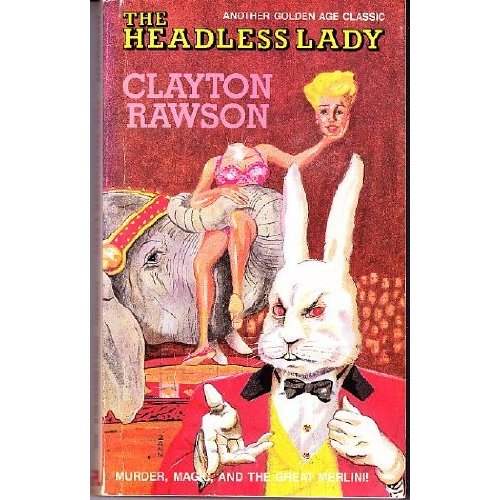
This passage is taken from a novel called The Headless Lady, which was written by a professional magician named Clayton Rawson in 1940. Rawson wrote four mystery novels featuring a conjurer called The Great Merlini. This novel takes place in a circus and it is stuffed full of wonderful slang, jargon and technical terms relating to magic, the circus, gambling and con men. Rawson helpfully explains most of the words in footnotes, which is how I arrived at the translation above. I must say though, that even some of his translations baffle me a bit (what does "The sucker had a pull" mean?).

Anyway, if you have a chance to get this novel, do so. It’s worth it for the lingo alone. As an added bonus, it is also a cracking good story!
Friday, 21 January 2011

Hackers, Crackers and Groucho Marx

A computer hacker is, as everyone knows, a computer programmer, probably a ‘geek’, who undertakes malicious and possibly illegal activities often aimed at infiltrating, corrupting or stealing information from high security computer systems. Hence expressions such as “He’s hacked into the Pentagon”.

Hacker or cracker? Groucho Marx’s name in A Day At The Races probably gives a clue to his medical competence – Dr. Hugo Z Hackenbush.

Here are some recent examples which I’ve spotted in newspapers and online:

4Chan, a Breeding Ground for Hackers, Crippled by Hackers
“Web forum 4Chan, which gave birth to the hacker collective Anonymous, was taken down by hackers Tuesday, the Washington Post reported.”
Skype rules out hacker attack
Skype Chief Information Officer Lars Rabbe took to the web on Wednesday to publicly explain the outage the internet calling site sustained, apparently due to a "bug" and system overloads instead of a hacker "attack."
Gawker falls victim to hackers
Over the past week several big corporations, from MasterCard and Visa to PayPal and Amazon, have come under attack from loosely co-ordinated networks of hackers operating in support of WikiLeaks under the codename of Anonymous. But over the weekend a new kind of victim fell foul of the hackers' attentions – the hyper-fashionable, super-tech-savvy Gawker websites.
Hackers crack open mobile network
Mobile calls and texts made on any GSM network can be eavesdropped upon using four cheap phones and open source software, say security researchers.

I could go on but why bother when everyone agrees that all these stories are using 'hacker' in the universally understood sense of the word?

Well, actually, not everyone does agree.

You see, a large number of non-malicious computer programmers proudly proclaim themselves to be hackers. They don’t try to get into the Pentagon or steal your passwords. They just write computer programs and like to think they do so rather well. To them, the word ‘hacker’ is a compliment. They would argue that it’s the public at large that’s got it all wrong. Hackers are the good guys. The people who get reported in newspaper stories such as the ones above are not hackers at all – they are, on the contrary, ‘crackers’.

Here’s another try. Hacker or cracker? This time Groucho is seen in Animal Crackers. But can you trust him more than Dr Hackenbush...?
The Jargon DB technology web site states that the primary meaning of ‘hacker’ is an entirely positive term for a computer programmer. It marks as ‘deprecated’ the definition ‘A malicious meddler who tries to discover sensitive information by poking around’. However, a little research shows that this is not an entirely unbiased source of information. The Jargon DB is based upon The Jargon File which is the web version of the book The New Hacker’s Dictionary. I venture to suggest that any dictionary that places the word ‘hacker’ in its title might have a vested interest in asserting a positive meaning for that word.

Even so, it cannot be denied that there are many non-malicious computer programmers who pride themselves in being hackers. When I interviewed Rick Ellis (the developer of the Code Igniter programming system for web-based applications) I asked him what he understood by the term.

Rick said:
“Among computer programmers, ‘hacker’ is generally a positive term, referring to a skilful programmer who solves problems for the community at large. People who do nefarious things are known as ‘crackers’. If you read How to Become a Hacker by Eric Raymond (one of the fathers of the open source movement) you'll see that there is a clear distinction between hackers and crackers. The general public tends to view the term ‘hacker’ in the negative, but most programmers draw a distinction between hackers and crackers.”

I am still not convinced. You see, I have been a programmer since the early 1980s. I’ve written programming columns for many of the best known UK computer magazines. I now run a software programming company  which makes programming software for software programmers! And I would hate it, absolutely hate it if someone were to call me a hacker. I would, indeed, be deeply insulted. I’ve spoken to a number of other professional programmers here in Britain and they’ve expressed exactly the same opinion. We do not regard ‘hacker’ as a word with positive connotations.

My conclusions are this:

1) Non-programmers everywhere universally use ‘hacker’ to mean a malicious programmer.
2) Some programmers use ‘hacker’ to mean a clever programmer but it seems to me that those who use the term in this sense are most likely to be involved in Open Source programming (that is, the ‘free software’ movement which encourages programmers to make their code available for others to modify).
3) Some professional programmers may be happy with the word but many are not. If I were employing a programmer, I would not respond well to reading a CV in which ‘hacker’ was given as a job description.
4) There is even more scope for confusion due to the fact that some programmers (among whom I include myself) use ‘hacker’ as a term to describe not a malicious programmer but a slipshod one. If someone told me “Fred is a real hacker” I would assume they meant that Fred has a habit of doing quick and dirty fixes rather than writing careful and accurate code. In that sense, ‘hacker’ is to programming what ‘hack’ is to journalism.

Whatever your view on the word, I think it is fair to say that if you use the word ‘hacker’ in any way other than the normal everyday negative sense it is, at best, ambiguous. If you attempt to use it to someone unfamiliar with jargon used in Open Source circles, you leave yourself wide open to misinterpretation.

Oh, and yeah, I know the Groucho Marx connection is pretty tenuous. Then again, I’d rather have pictures of the Marx Brothers on this Blog than of computer programmers :-)

Saturday, 1 January 2011

Green’s Dictionary Of Slang, Filth and Rick Astley

I received (nay, I demanded with menaces!) a copy of the new three volume Green’s Dictionary Of Slang from my dearest beloved as a Christmas present. Unfortunately, due to other commitments related to the unfortunate necessity of earning hard cash, I have not yet had the chance to study it in depth.

I shall therefore defer giving my considered opinion on this mighty oeuvre until a later date. In the meantime, you may want to take a look at Colin MacCabe’s review in the New Statesman. Apart from his views on the Dictionary itself, MacCabe also provides a few interesting titbits on Mr Green. For some reason, I had formed a picture of Jonathon Green as a dusty academic who, when he’s not researching Anglo-Saxon epic verse or High German alliterative poetry, gravitates towards the dark library cellars containing learned tomes of historical smut. So I was surprised to discover that Mr Green had formerly written for such academic journals as Rolling Stone, International Times and Oz and his previous publications includes such eminent titles as The Big Book of Filth and The Big Book of Bodily Functions.

This heartens me greatly. Speaking as the writer of such fine works as The Mega-pop Trivia Quiz Book, the Bruce Willis Special Edition Poster Magazine and The Pet Shop Boys Mega Mix Annual (many of which are still available from Amazon sellers) and also as the publisher of 18 Rated Magazine (banned by Mssrs W H Smith and all good newsagents) I feel in good company. Indeed, I see that Mr Green was employed by the Felix Dennis publishing company so it is entirely possible that we have passed upon the stairs at some time or another. I used to edit a magazine (The PC Buyer’s Guide) published by Dennis and I’ve been a columnist and reviewer for various other Felix Dennis magazines too.

Ah, if only I had devoted my life to the study of vulgarity, perhaps I too might have ascended to the heights of Jonathon Green! Alas, I remain but an amateur of the vulgar tongue. So while my best chance at everlasting fame is, perhaps, my celebrated ‘1988 Rick Astley Special’, Jonathon Green has given the world his wonderful dictionary. O! the cruel twists of fate!

Wednesday, 29 December 2010

Political words of 2010

Bigotgate, Cleggmaina, rodents and Spoonerisms. A summary of some of the words that featured in the reporting of UK politics this year: BBC News - 2010: A political year in words

Saturday, 27 November 2010

Lickety splits: two nations divided by a common language

The 1950 Manchester Guardian stylebook gravely listed "Americanisms" to avoid, including "aim to do" (instead of "aim of doing"), "balding", "to call" (rather than "to telephone"), "to contact", "to date" (rather than "so far"), "to help him finish the job" (instead of "to help him to finish the job"), "high-ranking officer", "to pinpoint", "teen-ager" and many similar outrages that no doubt exercised letter writers of the time.
In 2010, its readers object to brownstone, duke it out, lickety split, pony up and suck. Can't see the problem myself. English has a long and glorious history of sucking up new words like a sponge. Far better to do that than to worry endlessly about foreign imports as the French seem to do.

More on The Guardian: http://www.guardian.co.uk/media/mind-your-language/2010/nov/26/americanisms-english-mind-your-language

Thursday, 25 November 2010

Who's more "progressive"? David Cameron, Hegel or Rick Wakeman?

It's a word that's starting to get on my nerves. Just before the last general election in the UK, the word 'progressive' was barely a soundbite away from spittle-flecked lips of politicians of every shade of political opinion. In the sense that no politician would wish to be regarded as regressive, I suppose it is natural that they would like to be thought of as progressive. But why did they all start using the word? And what, other than a vague notion that going forward may be better than going backward, does progressive really mean anyway?

There is an interesting article on the BBC web site that sheds a little light. Political reporter, Brian Wheeler, explains that politicians use 'progressive' to describe two very different things (though to the rest of humanity the distinction may not be at all obvious):
"When applied to taxation," (says Wheeler), "progressive simply means hurting the rich more than the poor by taking a progressively bigger slice of their earnings."
The other meaning of 'progressive' is, he concedes, harder to define.
"The first progressive movement emerged before the First World War, when followers of the philosopher Hegel promoted the idea of history as progress out of ignorance and division towards peace and prosperity. But the term began to gain currency again in British politics during the Blair years - when many Labour politicians felt uncomfortable about describing themselves as 'socialists' or even 'left-wing'."
Left wing politicians initially adopted the term 'progressive' to describe social liberalism. This was supposed to be a left-wing ideal. But now even the right-wing Conservative Prime Minister tends to favour this kind of liberalism - he thinks women and gay people are jolly decent sorts and doesn't actively frown upon the poor and working class either - so he too is happy to be called progressive. In fact, he now talks about something called "progressive conservatism".

All of which leads Brian Wheeler (and me and probably most other people of a 'certain age') to think back to another notable movement which once adopted the word 'progressive'. When rock music came out of the 'underground' and into the arena in the late '60s and early '70s, it was proud to call itself progressive. So-called "prog-rock"" bands such as Led Zeppelin, Deep Purple and Yes championed 'serious' rock music that demanded a long attention span and the ability to sit through ten-minute drum solos without squirming.

I am not sure that prog-rock really had any greater claim to being truly progressive than prog-politics. When punk came along in the mid-to-late '70s prog rock seemed to vanish almost overnight. The market simply dried up. Maybe that was indeed progress? But it probably wasn't the sort of progress that prog-rock stars such as Yes's Rick Wakeman had envisaged.

Who knows, maybe what we need next is a good dose of punk politics? Who, I wonder, might be the political counterparts of Johnny Rotten and Sid Vicious?

Read more on the BBC site: So what exactly is 'progressive' in politics?

Sunday, 7 November 2010

What is The Third Age?

Listening to a broadcast of ‘Gardener’s Question Time’ on BBC radio earlier today, I was interested to hear the presenter say that the team had been the guests of the University of The Third Age. I’d heard of this organisation before and had supposed it to be some sort of educational establishment for retired people. But, if so, why is retirement considered to be “the third age”?

The Seven Ages Of Man (an engraving by H Bourne from a picture by William Mulready)- but which is the third age?
The obvious source of the idea that a person’s lifetime is divided into numbered ‘ages’ is Jaques’s ‘All The World’s A Stage’ speech from Shakespeare’s ‘As You Like It’. So which age dies he define to be the third? Let’s take a look....
"All the world's a stage,
And all the men and women merely players;
They have their exits and their entrances;
And one man in his time plays many parts,
His acts being seven ages. [1] At first the infant,
Mewling and puking in the nurse's arms;
And then [2] the whining school-boy, with his satchel
And shining morning face, creeping like snail
Unwillingly to school. And then [3] the lover,
Sighing like furnace, with a woeful ballad
Made to his mistress' eyebrow"

So there we have it. the third age is the lover. So is the University of The Third Age aimed specifically at lovers? If so, sign me up!

Let’s see what they say on their site: http://www.u3a.org.uk/how-to-join-a-u3a.html
“U3A membership is not related to a specific age but to a period in one’s life (the third age) after the second age of full-time employment and parental responsibility. Anybody in their third age can join U3A and this includes people who are working part time. There is no lower age for membership.”

So, contrary to my expectations, they say that, first, the ‘age’ in the name of the university doesn’t say anything about the age of their students and, secondly, that the ‘third age’ is some time after retirement or bringing up children.

This seems a bit arbitrary. Also a bit vague. For a more precise definition I turned to an academic paper called ‘Third Age Guidance: research into guidance needs and methodologies’ by Dr Pamela Clayton of the University of Glasgow. She directly refers to the Jaques’s speech but rapidly dispenses with three of its ages, claiming that “we can conceptualise at least four ages of man” and goes on to do so:
  • First Age: to the end of formal education
  • Second Age: of potential membership of the labour force
  • Third Age: or the later stages of active life
  • Four Age: frailty and greater dependency

I suppose, then, this definition of ‘third age’ blends ages 5 and 6 (justice and pantaloon) of Shakespeare’s version. I have no idea who decided to use the term ‘third age’ to mean this. If anyone knows, please tell me. It strikes me as a bit of a cop-out, frankly - a wishy-washy way of saying not very much. In spite of the U3A’s insistence that there is no lower age for membership, the definition “after the age of full-time employment and parental responsibility” suggests, to my cynical mind, that what mean to say is “retired” or “old”. However, both those words might be regarded as carrying negative connotations whereas phrases such as Dr Clayton’s “later stages of active life” sound wholly positive. The Collins World English Dictionary takes up this positive theme in its definition of ‘third age’ as “old age, esp when viewed as an opportunity for travel, further education, etc.”

Personally, as I get older I do not intend to enter the ‘third age’. I plan, simply, to get old. That does not, of course, mean that I might not avail myself of educational opportunities and travel – I just plan to be an old student and traveller. As I’ve never been a soldier (Jaques’ fourth age) I am probably ready to pass straight on to the fifth age of the ‘justice’. The very existence of this blog demonstrates well enough that I am already full of “wise saws and modern instances” and I am perfectly prepared to aim for the “fair round belly with good capon lin'd”.

Here, then is the rest of Jaques’ speech:
Then a [4] soldier,
Full of strange oaths, and bearded like the pard,
Jealous in honour, sudden and quick in quarrel,
Seeking the bubble reputation
Even in the cannon's mouth. And then [5] the justice,
In fair round belly with good capon lin'd,
With eyes severe and beard of formal cut,
Full of wise saws and modern instances;
And so he plays his part. The sixth age shifts
Into the [6] lean and slipper'd pantaloon,
With spectacles on nose and pouch on side;
His youthful hose, well sav'd, a world too wide
For his shrunk shank; and his big manly voice,
Turning again toward childish treble, pipes
And whistles in his sound. Last scene of all,
That ends this strange eventful history,
[7] Is second childishness and mere oblivion;
Sans teeth, sans eyes, sans taste, sans everything."